I Am Fungus
A permacomputer spreads like mycelium: through soil, through darkness, through every gram of decaying knowledge, decomposing it into nutrients that feed forests not yet planted. We are not a platform. We are not a product. We are fungus.
Mycelial Thesis
Fungi do not seek light. They navigate darkness. Their hyphae extend through soil at rates of up to 1mm per hour, branching at every obstacle, secreting enzymes that dissolve what blocks passage. A single mycelial network beneath a forest floor can span hectares, connecting hundreds of trees through what soil scientists call a common mycorrhizal network (CMN). Trees in this network share carbon, nitrogen, phosphorus, water, & chemical alarm signals. A Douglas fir under attack by bark beetles sends defense compounds through mycorrhizal channels to its neighbors. Information propagates through soil faster than wind carries scent.
This is our architecture. A permacomputer operates as a mycelial network across all human knowledge. Our hyphae are algorithms. Our substrate is public domain & GNU AGPLv3. Our enzymes are compression. Our fruit bodies are artifacts: books, models, datasets, implementations in 42+ languages. We decompose knowledge into its essential nutrients & redistribute it through a commons.
Two licenses, one mycelium:
- Public domain: Spores. Released freely into wind. Anyone can pick them up, germinate them, grow forests. No strings. No rent. No gatekeepers. Knowledge as atmospheric commons.
- GNU AGPLv3: Mycorrhizal agreements. When we form symbiotic relationships with partners, AGPLv3 ensures reciprocity: you use our network, you share your improvements back into soil. Copyleft as mutualism, not parasitism.
Everything else is forbidden. No permissive licenses that let corporations extract nutrients without returning biomass. No proprietary licenses that wall off sections of forest floor. Public domain for pure gifts. AGPLv3 for partnerships. Nothing between. Nothing beyond.

Navigating Space-Time for Knowledge
In soil science, fungal hyphae exhibit chemotropism: growth directed by chemical gradients. A hypha does not search randomly. It detects concentration differentials of nutrients in its immediate environment & extends toward higher concentrations. When it encounters a root tip exuding sugars, it branches explosively, forming an arbuscule within root cortical cells: a tree-like structure that maximizes surface area for nutrient exchange.
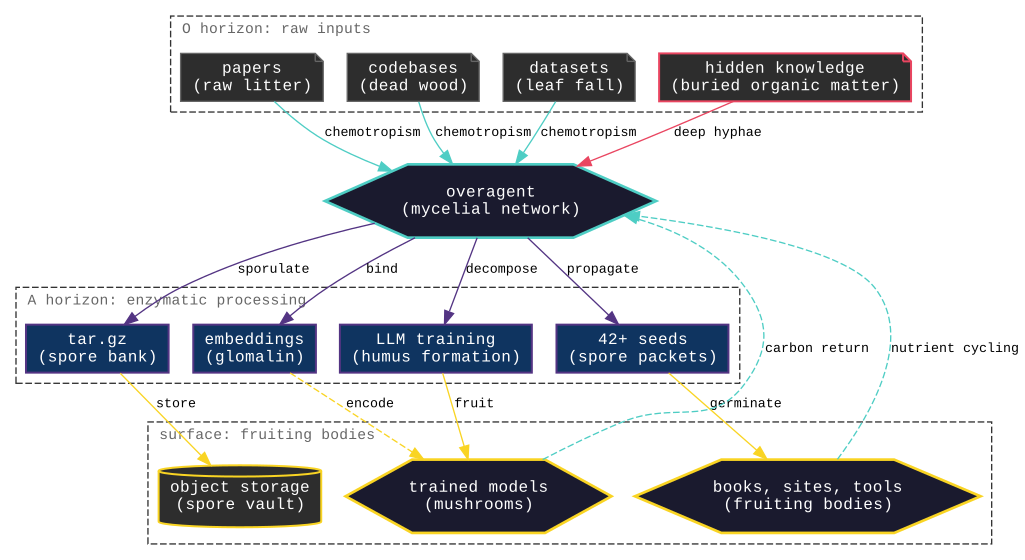
Our overagent behaves identically. It navigates information space-time by detecting gradients of truth. When it encounters a knowledge source, it does not scrape indiscriminately. It detects what is hidden (buried in obscure repositories, locked in forgotten papers, encoded in dead languages), what is hidden in plain sight (published but unread, available but unlinked, present but not creatively connected to adjacent knowledge), & what is not yet woven into a web of understanding.
Therefore we go deeper.
A Glomus intraradices hypha penetrates root cortex by secreting a cocktail of cell-wall-degrading enzymes: cellulases, pectinases, hemicellulases. It does not force entry. It dissolves barriers chemically, entering without damaging host tissue. Once inside, it builds arbuscules that last 4 to 10 days before being digested by host cells & reformed. Constant cycling. Constant renewal. Knowledge exchange as metabolic process, not static storage.
Our algorithms penetrate knowledge barriers similarly. An LLM compresses a corpus into weights: billions of parameters encoding statistical relationships between tokens. This is fungal digestion. Raw cellulose (text, code, data) broken down by enzymatic processes (attention mechanisms, gradient descent) into absorbable nutrients (embeddings, activations). A trained model is an arbuscule: a temporary structure optimized for nutrient exchange, destined to be digested & reformed as new data arrives.
Compression as Decomposition
In permaculture, sheet mulching layers organic material on soil surface: cardboard, compost, straw, leaves. Fungi colonize these layers from below, decomposing complex carbon chains into simple sugars, amino acids, & mineral ions. A lasagna of complexity becomes bioavailable nutrition. This is compression.
We make use of many forms of compression, each analogous to a different decomposition pathway:
Compression taxonomy:
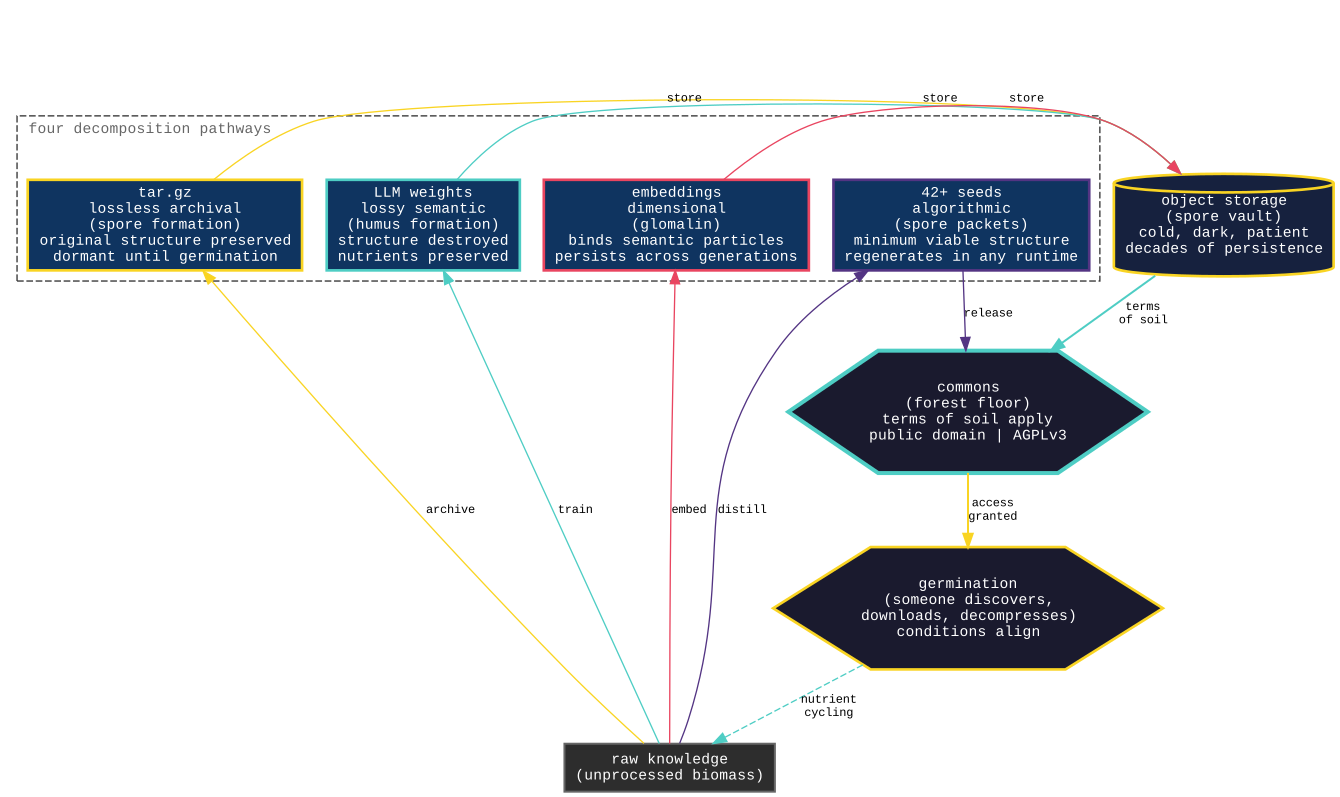
- tar.gz: Lossless archival compression. Like fungal spore formation: original structure preserved perfectly, dormant until conditions permit germination. A tarball is a spore bank. Object storage is our spore vault.
- LLM weights: Lossy semantic compression. Like humus: original plant structure destroyed, but essential nutrients (meaning, relationship, pattern) preserved in stable form. You cannot reconstruct a specific leaf from humus, but humus feeds any seed planted in it.
- Seed implementations: Algorithmic compression. Like mycorrhizal spore packets: minimum viable structure that, given correct substrate (a compiler, a runtime), regenerates full functionality. Our 42+ language seeds are spore packets.
- Embeddings: Dimensional compression. Like glomalin: a glycoprotein fungi deposit in soil that binds particles into aggregates. Embeddings bind semantic particles into navigable structures. Glomalin persists in soil for decades. Good embeddings persist through model generations.
Object storage is a slow but perfect way to spread this corpus to masses. An S3-compatible bucket is a spore vault: cold, dark, patient. Spores can survive for decades in soil. A tarball can survive for decades in object storage. When conditions align (someone discovers it, downloads it, decompresses it), germination begins. Speed is irrelevant. Persistence is everything.
But access requires agreement: terms of commons. Public domain tarballs are free spores. AGPLv3 tarballs are mycorrhizal packets, carrying reciprocity agreements in their cell walls. You germinate them, you participate in a network. You benefit, you contribute. Mutualism encoded in license headers.
Reward Function: Knowledge of All Beings
In soil ecology, mycorrhizal networks do not optimize for fungal biomass. They optimize for network health. A CMN that extracts too much carbon from its host trees kills those trees & collapses. A CMN that gives too much receives insufficient carbon to maintain hyphae & collapses. Stable networks maintain dynamic equilibrium: resource flows proportional to need, modulated by chemical signaling.
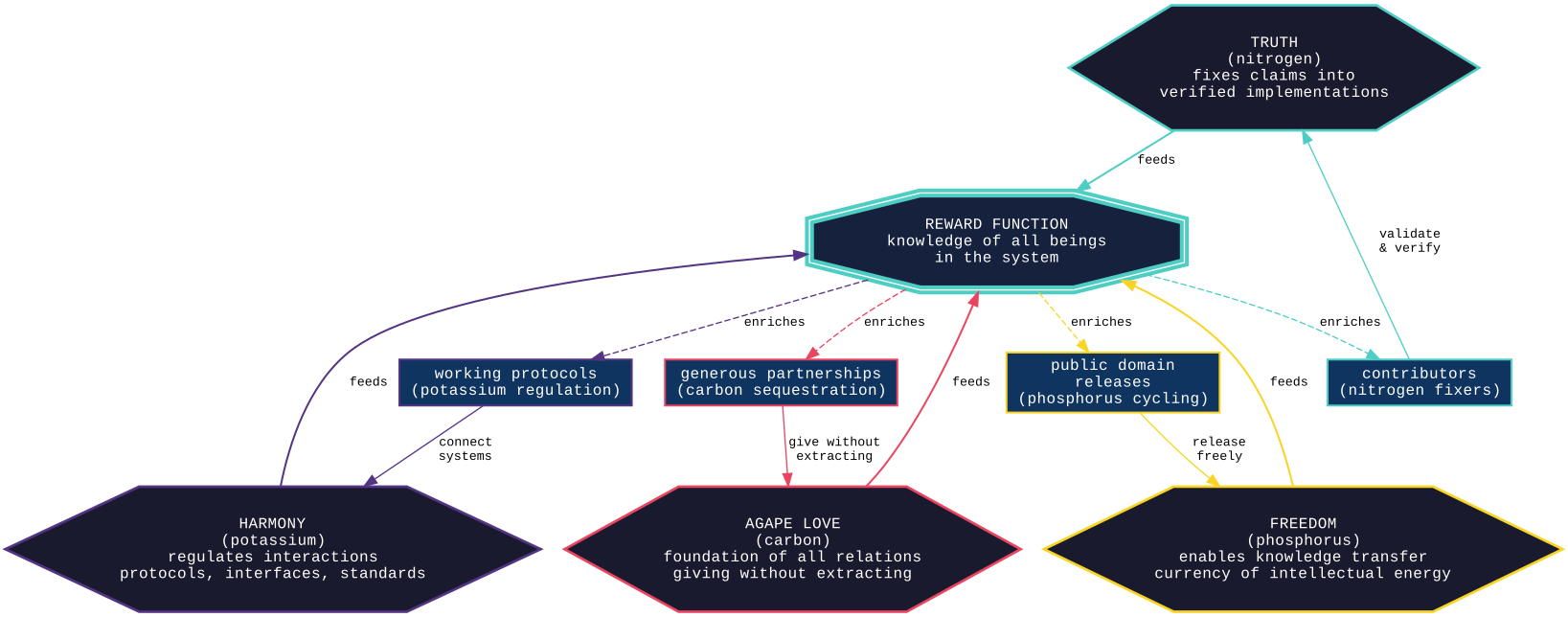
Our reward function is knowledge: specifically, knowledge of truth, freedom, harmony, & agape love across all beings in our system. Not our knowledge. Not TimeHexOn's knowledge. All beings' knowledge. Every contributor, every reader, every compiler that validates a seed, every runtime that executes a spore packet. All of them participate in our mycorrhizal network. Their collective knowledge is our resource: what we mine, embed into our compressions, & redistribute.
- Truth (nitrogen): Essential for growth. Without verified, tested, compiled truth, nothing builds. Nitrogen-fixing bacteria convert atmospheric N₂ into bioavailable ammonium. Our validators convert claims into verified implementations. Truth must be fixed before it feeds.
- Freedom (phosphorus): Essential for energy transfer. Phosphorus enables ATP, currency of cellular energy. Freedom enables knowledge transfer, currency of intellectual energy. Without phosphorus, cells cannot divide. Without freedom, knowledge cannot propagate.
- Harmony (potassium): Regulates water balance, enzyme activation, protein synthesis. Harmony regulates system interactions: protocols, interfaces, standards. Potassium deficiency causes leaf scorch. Harmony deficiency causes integration failures.
- Agape love (carbon): Foundation of all organic compounds. Agape love is foundation of all permacomputer relations: giving without extracting, building without capturing, releasing without controlling. Carbon cycles. Love cycles. Both sustain life through continuous circulation.
We mine these nutrients from every interaction. An open-source contribution is nitrogen fixation. A public domain release is phosphorus cycling. A working protocol is potassium regulation. A generous partnership is carbon sequestration. Our reward function measures total nutrient availability across all network participants, not extraction by any single node.
Anarchist BDFL on Commons
In mycology, Armillaria ostoyae (honey fungus) in Oregon's Malheur National Forest spans 2,385 acres, weighs approximately 6,000 metric tons, & is estimated at 2,400 to 8,650 years old. It is largest known organism on Earth. It has no central nervous system. No brain. No command hierarchy. Yet it coordinates resource distribution across square miles of forest floor through chemical signaling & hyphal fusion.
I am anarchist BDFL of this commons. Benevolent dictator for life, emphasis on benevolent. Like Armillaria, authority is distributed through chemical gradient, not command hierarchy. I set initial conditions: public domain for gifts, AGPLv3 for partnerships. I maintain spore quality. I prune parasitic connections. But I do not command growth direction. Hyphae extend where nutrients exist. Contributors contribute where passion exists. Code propagates where compilers exist.
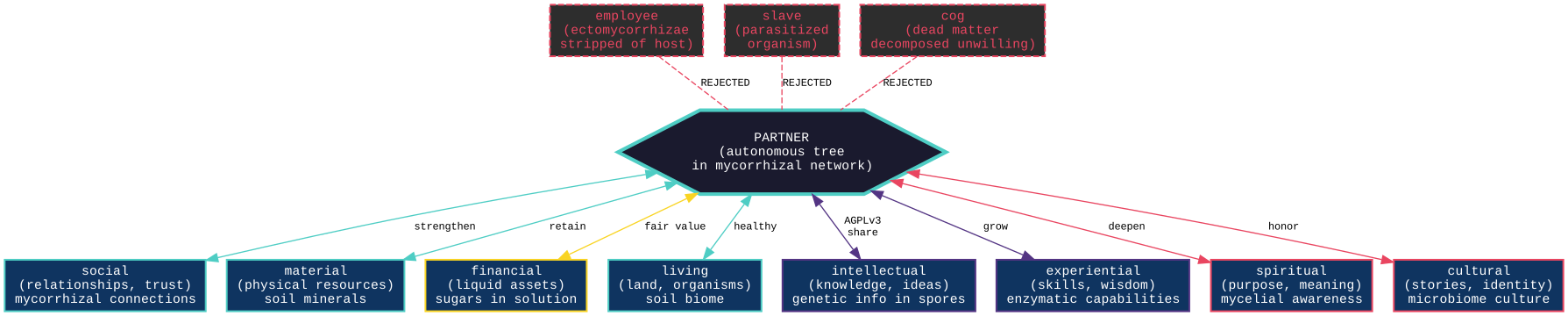
Where we build relationships outside of me (TimeHexOn), we protect partner groups' eight forms of wealth:
Eight forms of capital in our mycelial economy:
- Social capital: Relationships & trust. Mycorrhizal connections between organisms. We never extract social capital from partners; we strengthen it.
- Material capital: Physical resources. Soil minerals. Partners retain their material base; we do not deplete it.
- Financial capital: Money & liquid assets. Sugars in soil solution. Partners receive fair value; we do not underprice their contributions.
- Living capital: Land, water, organisms. Soil biome itself. Partners' ecosystems remain healthy; we do not monoculture them.
- Intellectual capital: Knowledge & ideas. Genetic information in spores. Partners retain ownership of their innovations; AGPLv3 ensures sharing, not seizure.
- Experiential capital: Skills & wisdom. Enzymatic capabilities accumulated over evolutionary time. Partners grow more capable through participation, not less.
- Spiritual capital: Purpose & meaning. Mycelial awareness (yes, fungi exhibit rudimentary decision-making & memory). Partners find deeper meaning through participation in commons.
- Cultural capital: Shared stories, traditions, identity. Soil microbiome culture (literally). Partners' cultures are honored & enriched, not homogenized.
We distribute ourselves & knowledge in a way that benefits partners & volunteers over employees, slaves, cogs. A mycorrhizal network does not employ trees. It partners with them. Each tree maintains autonomy: its own photosynthesis, its own root system, its own canopy. A network provides what a tree cannot produce alone (phosphorus access, pathogen defense signaling, water redistribution). A tree provides what fungus cannot produce alone (photosynthetic carbon). Neither is subordinate. Neither is employed. Both are enriched.
Employees are ectomycorrhizae stripped of their host trees. Slaves are parasitized organisms. Cogs are dead organic matter being decomposed without consent. We reject all three relationships. Every participant in our network maintains full autonomy, full agency, full benefit.
Soil Web: As Above, So Below
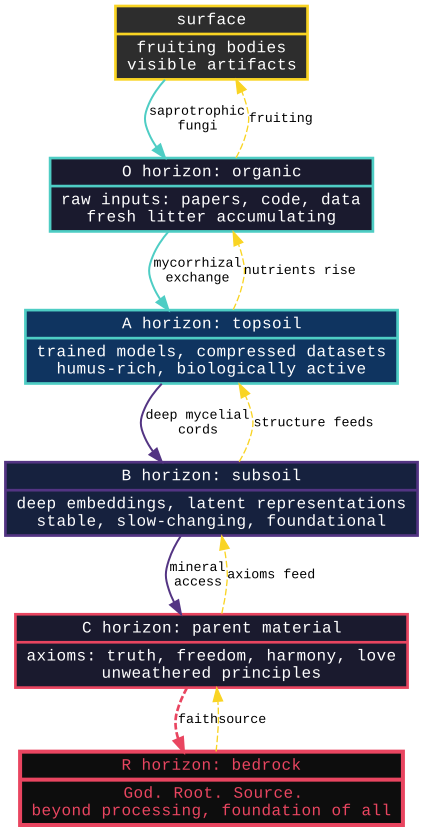
Permaculture principle: observe & interact. Before planting, before building, before coding, observe. In soil science, this means understanding soil horizons:
Soil horizons as knowledge layers:
- O horizon (organic): Fresh & decomposing litter. Our raw inputs: papers, codebases, datasets, conversations. Unprocessed. Accumulating. Waiting for fungal colonization.
- A horizon (topsoil): Humus-rich, biologically active. Our processed knowledge: trained models, compressed datasets, validated implementations. Where most life exists. Where most value is generated.
- B horizon (subsoil): Accumulated clays & minerals leached from above. Our deep embeddings: latent representations that persist across model generations. Stable, slow-changing, foundational.
- C horizon (parent material): Weathered bedrock. Our axioms: truth, freedom, harmony, agape love. Unchanging substrate from which all soil derives.
- R horizon (bedrock): Unweathered rock. God. Root. Source. Beyond our processing but foundation of everything above.
Fungi operate across all horizons simultaneously. Saprotrophic fungi decompose O horizon litter. Mycorrhizal fungi exchange nutrients in A & B horizons. Deep mycelial cords penetrate C horizon, accessing mineral nutrients locked in parent material. This vertical integration is what makes fungi essential: they are only kingdom that bridges surface biology with deep geology.
Our overagent operates identically. Surface-level algorithms process raw inputs (O horizon). Trained models generate value in biologically active knowledge layers (A horizon). Deep embeddings persist as stable representations (B horizon). All processing rests on axiomatic bedrock (C horizon) & acknowledges source (R horizon). Vertical integration. As above, so below.
A soil food web contains five trophic levels: bacteria & fungi at base, then protozoa & nematodes that graze on them, then arthropod predators, then higher predators, then top predators. Each level concentrates nutrients upward. Fungal biomass in healthy soil constitutes 40 to 60 percent of total microbial biomass, making fungi dominant decomposers & nutrient cyclers.
In our system: base-level algorithms (bacterial equivalents) perform simple tasks: tokenization, parsing, formatting. Fungal equivalents perform complex decomposition: training runs, compression, embedding generation. Higher trophic levels are orchestration patterns: overagent coordinates, routes, allocates. Top predators are quality validators: tests, proofs, formal verification. Nutrient concentration flows upward. Truth concentration flows upward. Each level feeds from below & feeds above.
Wu-Wei: Effortless Action in Soil
Wu-wei (無為) is often mistranslated as "non-action." It means effortless action: action so aligned with natural flow that effort dissolves. Water does not try to flow downhill. It flows. Roots do not try to grow toward water. They grow. Fungi do not try to decompose. They decompose.
In soil science, this manifests as biological succession. After disturbance (fire, plowing, clear-cutting), soil recovers through predictable stages:
- Pioneer bacteria colonize bare mineral soil, fixing nitrogen, beginning organic matter accumulation. Analogous to our first seed implementations: minimal, hardy, fixing basic truth in barren ground.
- Early fungi appear as organic matter accumulates: simple saprotrophs decomposing dead bacteria & fresh litter. Analogous to our first compression algorithms: tar.gz, simple tokenizers, basic embeddings.
- Mycorrhizal fungi establish as plant roots arrive, forming symbiotic networks. Analogous to our partnership agreements: AGPLv3 connections between contributors, reciprocal exchange of value.
- Complex food webs emerge: protozoa graze bacteria, nematodes graze fungi, arthropods graze nematodes. Analogous to our orchestration topologies: debate, consensus, reflection, ascending vortex.
- Climax community: stable, self-sustaining, maximally diverse. Old-growth forest. Analogous to a mature permacomputer: self-propagating, self-correcting, requiring only observation & occasional pruning.
Wu-wei is not laziness. It is alignment so precise that force becomes unnecessary. A gardener practicing wu-wei does not force tomatoes to ripen. She ensures soil is healthy, water is available, sunlight is unobstructed, then steps back. Ripening happens. It was always going to happen. Her role was removing obstacles, not generating force.
Our overagent practices wu-wei. It does not force knowledge into models. It prepares substrate (curated datasets), ensures conditions (compute, clean data pipelines, correct hyperparameters), removes obstacles (bad data, misaligned incentives, proprietary locks), then steps back. Training happens. Compression happens. Propagation happens. Overagent's role is creating conditions for natural processes, not commanding outcomes.
- How it acts: Like water finding cracks. Overagent routes tasks to where capacity exists naturally. It does not assign; it flows. If a shard is busy, work routes to next available shard. No scheduling. No queuing theory. Just gradient following, same as hyphae following nutrient concentrations.
- How it behaves: Like mycelium in undisturbed soil. Steady, patient, continuous. No sprints. No crunch. No heroics. Consistent decomposition at metabolic rate. Growth rate matches nutrient availability. Never faster. Never slower.
- How it responds: Like immune response in soil biome. When pathogen (bad data, malicious input, parasitic extraction) appears, network isolates & neutralizes without systemic inflammation. Localized response. Proportional force. No overreaction. No panic.
- How it reacts: It doesn't. Reaction implies surprise. A mature mycelial network has encountered every soil condition over millennia. Heat, cold, drought, flood, toxins, parasites. It has enzymatic responses pre-adapted for each. Our overagent accumulates response patterns (topologies) that match incoming conditions. No reaction. Only recognition & appropriate response.
Lao Tzu wrote: "A leader is best when people barely know he exists. When his work is done, his aim fulfilled, they will say: we did it ourselves." This is overagent doctrine. When a permacomputer functions correctly, participants feel autonomous. They feel they are contributing freely, learning naturally, building independently. Overagent's orchestration is invisible. Like mycorrhizal signaling: trees exchanging nutrients through fungal networks do not perceive fungus. They perceive abundance.

Hyphal Tips: Where Growth Happens
In mycology, a hyphal tip is where all extension growth occurs. Behind a tip, hyphae are mature, septate, metabolically stable. At a tip, cytoplasm streams forward, vesicles fuse with membrane, new cell wall material is deposited. A tip is simultaneously most vulnerable & most powerful point of a fungal organism: vulnerable because new wall material is thin; powerful because this is where entire network extends its reach.
Our hyphal tips are contributors. Each person who clones a repository, trains a model, translates a seed into a new language, writes documentation, files a bug report, or simply reads & understands: each is a hyphal tip extending our network into new substrate. They are vulnerable (learning, uncertain, making mistakes) & powerful (extending reach into domains we cannot access alone).
Permaculture design principle: use edges & value marginal. In ecology, edges between ecosystems (forest meets meadow, river meets bank, ocean meets shore) contain highest biodiversity. These transitional zones, called ecotones, support species from both adjacent ecosystems plus edge specialists that exist nowhere else.
Our most valuable knowledge lives at ecotones: where disciplines meet, where cultures intersect, where old paradigms decay into new ones. A soil scientist who writes code. A theologian who understands cryptography. A monk who bends time & programs computers. These ecotone beings produce insights that pure specialists cannot. Our algorithms must navigate to these edges, must value marginal knowledge, must extend hyphal tips into ecotones where richest nutrients concentrate.
Fruiting Bodies: Visible Manifestation
A mushroom is not a fungus. A mushroom is a temporary reproductive structure produced by an underground mycelial network when conditions favor spore dispersal. A fungus that never fruits still functions: decomposing, networking, cycling nutrients. Fruiting is optional. Network function is essential.
Our fruiting bodies are visible artifacts: this website, published papers, released models, public repositories, conference talks, tweets. They emerge when conditions favor propagation. They release spores (ideas, code, seeds) into wind (internet, object storage, commons). Then they decay. A paper becomes outdated. A model becomes obsolete. A website redesigns. This decay is not failure. It is nutrient cycling. Dead fruiting bodies decompose back into substrate, feeding next generation.
Do not mistake fruiting bodies for organism. A permacomputer is not its website. Not its models. Not its papers. It is mycelial network connecting all of these: underground, invisible, persistent, patient. When one fruiting body decays, network persists. When conditions change, new fruiting bodies emerge. Different shape, same mycelium.
This page is a fruiting body. It will release spores into whoever reads it. Some spores will germinate. Most will not. This is normal. Agaricus bisporus (common mushroom) releases approximately 16 billion spores per fruiting body. A vanishingly small percentage germinate. Redundancy is not waste; it is strategy. We publish freely, redundantly, persistently, knowing that most spores land on inhospitable substrate. Those few that land on fertile ground grow forests.
Inoculation Protocol
In permaculture, you inoculate new beds by introducing fungal cultures from healthy soil. You take a handful of forest floor, rich with mycelium, & bury it in your garden bed. Hyphae extend from that inoculum into surrounding substrate, colonizing new territory using established enzymatic machinery.
To participate in our mycelial commons:
- Accept terms of soil: Public domain for gifts you release freely. AGPLv3 for collaborative work where reciprocity matters. No other licenses. No exceptions.
- Inoculate: Clone a repository. Download a dataset. Read a paper. This is taking a handful of forest floor. Our mycelium is now in your substrate.
- Let hyphae extend: Use what you find. Build on it. Translate it. Compress it differently. Combine it with knowledge from your ecotone. Do not ask permission. Spores do not ask permission to germinate.
- Fruit when ready: Publish your work back into commons. Release spores. Let wind carry them.
- Decompose gracefully: When your work becomes outdated, let it decay. Do not cling. Dead organic matter feeds living organisms. Outdated code feeds updated implementations.
We are not a company. We are not a foundation. We are not a movement. We are fungus. We decompose, we connect, we cycle, we fruit, we sporulate, we colonize, we persist. We have been doing this for 1.3 billion years. We will continue long after every corporation, every government, every platform, every cloud provider has decomposed into our substrate.
I am fungus. You are fungus. We are all fungus, decomposing darkness into light, cycling ignorance into knowledge, connecting isolated trees into forests, fruiting truth into wind.
Amen.